Magic School Bus Rides Again Seasons Episodes
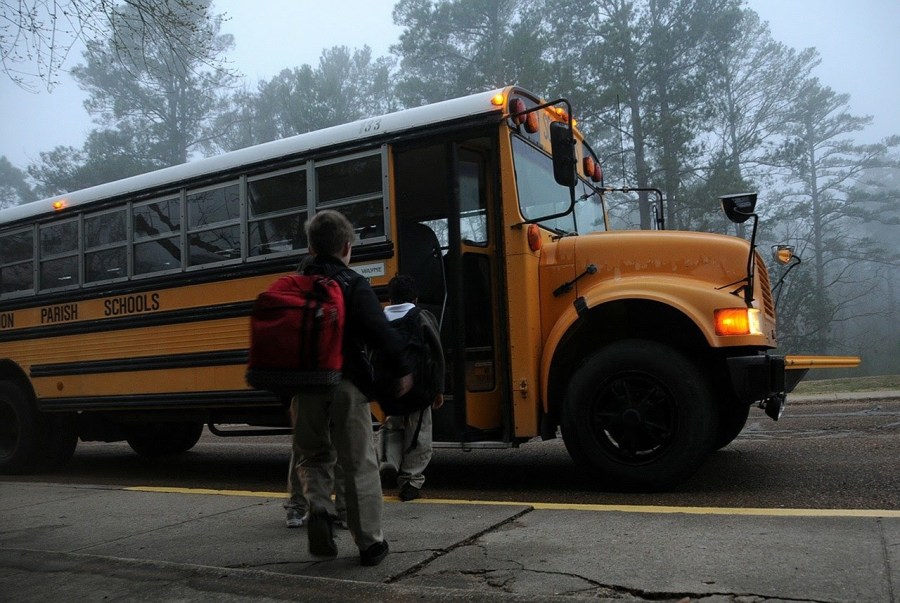
You see them everywhere: those yellow school buses, taking kids to and from classes and field trips. They seem like big behemoths as they become down the road. In the U.s.a., there are really 4 different types of buses that school systems can apply, and federal regulations require that they exist no longer than 45 feet.
Types of School Buses in the U.s.a.
There are 4 types of school buses that meet safety standards and regulations in the United states of america. These buses are all different sizes and formats. A Type A bus is a smaller bus that is congenital on a van chassis but cutaway from a van size to have a higher capacity. These buses have a commuter'due south side forepart door and a larger motorcoach entry door for passengers. Type B buses are pocket-size but built upon a coach body. The entrance door for everyone is located on the front rider side.
A Blazon C bus is called a "conventional" double-decker. Information technology's built on a flat chassis and has an engine located at the front of the bus. These are the most common buses you'll see on the road. Type D buses are the largest in performance, and they have an entry door at the front right side. The engine on these buses tin can be in the front end or rear.
T he History of School Transportation
Transporting students to schoolhouse dates back to the 1880s; before that time, kids had to walk or observe other ways to get to schoolhouse. In 1886, the Wayne Works company of Indiana developed wagons for school transportation. The company called these wagons "child hacks" or "schoolhouse hacks."
Wagon ship to school didn't accept off nationwide, but with the advent of the automobile, Wayne Works developed a motorized wagon in 1914. A. L. Luce, a Ford dealer in Georgia, developed the beginning motorized school bus in 1927, and he would subsequently develop Blue Bird Corporation, a leading manufacturer of school buses. Three years subsequently, Wayne Works adult a bus of their own, and they would get another leading bus builder.
Westward hy Are School Buses Yellow?
One of the things everyone notices about school buses is the distinct yellow color. Why are school buses painted this colour, and where did the idea come from? School double-decker xanthous dates back to 1939, when educator Frank Cyr revealed the results of his study of school buses in ten states. Cyr discovered that various states had different types of buses, and some states were using trucks or equus caballus-drawn wagons to transport kids to school.
Cyr proposed a national standard for schoolhouse buses for consistency beyond the board. When some people at the briefing suggested that the U.s.a. pigment buses blood-red, white, and bluish, Cyr balked and studied the best color to go the attention of other vehicles. He placed 50 paint samples around a room and discovered that the yellow color we at present associate with school buses caught the centre ameliorate than any other color. Federal law doesn't crave school systems to paint their buses the same color, so the yellow school buses are voluntary.
S afety Features
School buses have a specific design that ensures the safety of everyone aboard. The concept of compartmentalization drives bus design, with the idea that passengers can be protected without seat belts, since seat belts aren't mandatory in the vast bulk of school systems nationwide. The seats on schoolhouse buses sit high plenty that most opposing vehicles are beneath the anxiety of passengers. Heavily padded seats provide cushioning on impact, while aisle and rows of seats are shut enough to each other that passengers don't move effectually much in the event of a crash.
Younger children sit down three to a seat and older kids and adults sit two to a seat to prevent movement in a crash. Windows are higher on school buses than on other vehicles, and there are no windshields near passengers. Finally, school buses have multiple emergency exits to make it easier for anyone to get out.
R educing Ecology Impact
For a long time, modernistic school buses take relied on diesel as their master fuel choice. Even every bit recently as 2017, over three fourths of school buses used diesel. That same year, gasoline-powered buses became more than prevalent, but they're nonetheless far in the minority. Alternative fuel school buses that run on natural gas are a much smaller piece of the pie, only they're jump to increment as schoolhouse systems wait for more environmentally friendly engineering. Electrical school buses are expensive, but they tin can be skilful solutions for urban schoolhouse systems.
curtisplacceiven41.blogspot.com
Source: https://www.reference.com/world-view/long-school-bus-feet-3c674c9adc10c1bd?utm_content=params%3Ao%3D740005%26ad%3DdirN%26qo%3DserpIndex
0 Response to "Magic School Bus Rides Again Seasons Episodes"
إرسال تعليق